
HISTORY AND CULTURE OF MEXICO: A Rosa by any other name
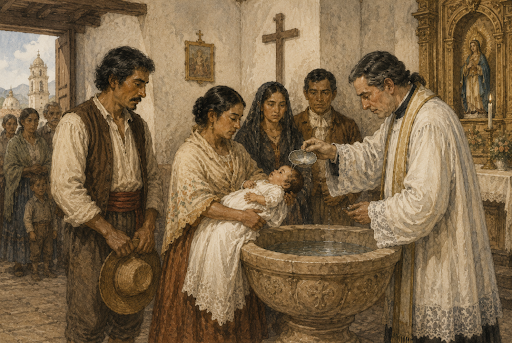
Names are an intricate and fascinating matter anywhere, but in Latin America and particularly in Mexico, they take on an additional level of complexity. For Catholic Mexicans—the majority of the population—the first name traditionally corresponded to the saint on whose feast day the child was born. The Catholic Church recognizes over 10,000 named saints, so there is no lack of those names for any newborn. During the viceregal period, giving your child a saint’s name was strongly encouraged by the parish priest.
Today, newborns in Mexico tend to be given names according to their parents’ tastes; more exotic and foreign first names are common. A young woman I recently met had an obvious Russian first name before her very Spanish last name. She explained that she was named for the hero of a Russian novel her mother was reading when she was expecting her. Another, named Cassandra, did not know why. She was amused when I told her the Greek myth connected to that name.
What about surnames? This is probably the most confusing matter for English speakers who are used to just one last name—belonging to the father’s family. In Mexico, there are at least two, making it difficult to address a Juan Ramirez Lopez. Is it Mr. Ramirez? Or is it Mr. Lopez? The easy answer is that you would address the person by the first surname, which is the paternal one. The last surname is the mother’s last name. For an English speaker with only a first and last name, there will usually be a puzzled look as if something has been withheld. In Mexico, Ralph Waldo Emerson would most likely be addressed as Mr. Waldo.
Many cultures took the name of a male ancestor, with the addition of a suffix meaning “son of” creating surnames for the descendants. In English, this led to names such as Jackson from Jack, or Johnson from John. Scandinavian countries used the suffix “sen,” and Scottish and Irish used the prefixes “Mac” or “Mc” to mean “the son of.” In Spanish, a male first name added the suffix “ez” or “es” to create surnames such as Hernández for the sons of Hernando or González for the sons of Gonzalo.


Another common way to create a surname was to adopt an ancestor’s craft, physical characteristic, or personal trait. These led to some fascinating results: Carter, transporter of carts; Chandler, candle maker; Armstrong, notably strong arms; Reed or Reid, red hair; Goodman, a respectable man; and Meek, a humble person. The same happens in Spanish with the representation of a craft in the last name Herrero (ironworker); a physical characteristic with Delgado (skinny); and a personal trait with Bravo (brave).
Most Indigenous peoples in pre-Hispanic Mexico did not have hereditary surnames in the European sense. They typically had personal names, lineage affiliations, noble titles, place-name associations, or clan identities. When the Spanish introduced Christian baptism and European-style record-keeping, Indigenous people often had to acquire surnames for legal and ecclesiastical purposes. Many chose the surname of a Spaniard they admired—such as the child’s godfather or the property owner on whose hacienda they labored. One also finds names of plants or animals in the making of surnames: Conejo, rabbit; Pirul, the ubiquitous pepper tree, or Vaca, cow. ¹
Aside from the uniqueness of using both paternal and maternal names, nicknames are generally more pervasive and socially important in Mexico. They are often used as the primary form of address. Friends, relatives, and even entire communities may know someone primarily by that nickname, with acquaintances unaware of the person's legal name. This became clear when I interviewed the captain of one of the oldest squadrons of the Los Locos parade—el Gordo Ledesma. Mr. Ledesma, whose first name is Emigdio, goes by “El Gordo” and is known by that nickname in town. It was hard for me to address him as that; I called him Don Emigdio. But when looking for his workshop in the neighborhood, nobody knew him other than “El Gordo”!
Mexican nicknames are most often acquired in childhood. Mr. Ledesma used to be a chubby toddler and was given his nickname then, though his physique is the opposite of what it represents. Many such nicknames could be considered offensive by outsiders—La Chata, one with a flat nose, or el Pelón, the bald one; but most are given affectionately by family or friends and are perceived that way.
A few nicknames are standard for a particular first name, just as they are in English where Margaret almost always becomes Peggy, and Robert becomes Bob. Traditionally in Spanish José (Joseph) becomes Pepe, because St. Joseph is considered the adoptive father of Jesus, which in Latin is Pater Putativus. The initials, when stated in Spanish as the double letter “P” become Pepe. The nickname Paco, from Francisco, also has religious roots. It refers to St. Francis of Assisi, who was considered “father of the community,” which in Latin is Pater Comunitatis. The nickname is formed by the first two letters of each word.
Many Mexican historical figures were known almost exclusively by their nicknames. There are several examples of such individuals in San Miguel. Pedro Vargas, a famous Sanmiguelense singer of the 1930s, is best known as “El Samurai” because of his slanted eyes, reminiscent of Asian ancestry. A man who played a significant role during the first phase of the War of Independence, born in a home on Barranca in town, was Juan José de los Reyes Martínez Amaro. But he is best remembered as “El Pípila,” the stoneworker who strapped a slab of stone on his back and crawled to the entry of the fortress-like La Alhondiga in Guanajuato, to set fire to the door so the insurgents could rush in and kill the Spaniards hiding within.
And finally, one of the most important intellectuals who was born in San Miguel in 1818 was better known by his pseudonym “El Nigromante.” Not only was he a prodigious writer, essayist, and poet, he was also instrumental in creating a modern Mexico out of a Spanish colony. As a member of the Constituent Congress of 1856, he helped draft a modern and liberal constitution that separated Church and State, instituting secular and free education for all.

He chose his nickname with care. El Nigromante means necromancer: someone who delves into magic and communes with the dead. Ignacio Ramírez did not believe in any of that, but he saw himself as a destroyer of the old systems imposed by the Spanish conquerors. In Miguel de Cervantes’s work, Don Quixote confronts demons and magicians—whom he calls Necromancers—who drive him crazy. It seems that Ramírez saw himself as a figure who drove the existing, conservative system crazy. And he did!
If you are interested in finding out more about this amazing historical figure, come to a two-part, bilingual lecture on June 19 and 22 at Casa Nigromante (the house where he was born), on Umaran 38.

¹ López Espinosa, José Cornelio. La Villa de San Miguel el Grande y Ciudad de San Miguel de Allende. Guanajuato: Gobierno del Estado de Guanajuato, 2010.


Natalie. I thoroughly enjoyed this. Thanks for sharing! See you at the lecture