
October 12: Beyond Columbus and the Myth of Discovery
We recently visited southern Spain, and one of the cities on our itinerary was Huelva, in Andalusia, near the Portuguese border. Huelva earned its place in history because of three ships that left its port on August 3, 1492 heading west across the Atlantic to find a western sea route to the Indies and the lucrative trade in spices and other goods. The commander of the expedition, Cristopher Columbus, believed he could reach Asia by sailing west across the Atlantic, rather than following the established routes eastward. What he did not expect was a vast continent that lay between Europe and Asia.
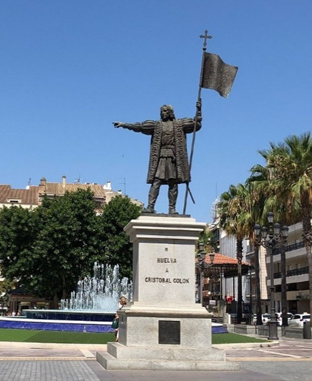
In the city, we encountered a statue of Columbus, his right arm extended, pointing toward the sea. The gesture was confident and purposeful, as if directing our gaze toward the promise of a new world. And we found the Spanish quite proud of their man, still believing he was one of the greatest navigators—which he probably was—and that his accomplishment was a great triumph.
That is the story we have been told for more than five centuries. The historical data is accurate, he did cross the Atlantic and arrived in America. But did he discover it? And, more importantly, what exactly did it all mean?
On the morning of October 12, 1492, Christopher Columbus came ashore on a small island in the Bahamas. The people who lived there were the Lacayan, part of the Taino population, and they called their island Guanahani. When they spotted the giant, sea vessels they swam out to meet the strangers. They brought gifts to welcome them: parrots, cotton thread, and spears.
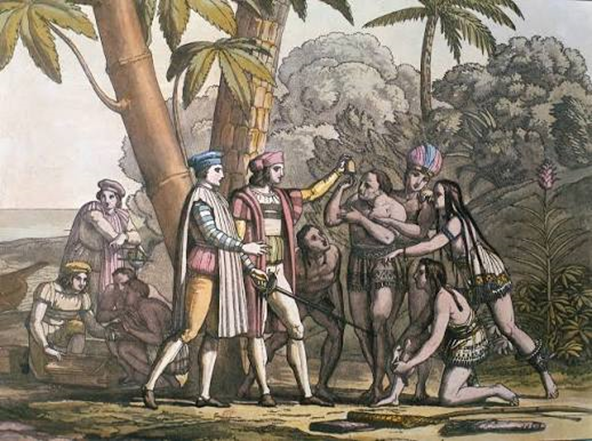
Columbus recorded this welcome in his log. He also recorded his impression that they would make good servants.
Perhaps that final, short statement encapsulates the entire meaning of that discovery.
But who discovered whom? In 1492, the Americas held tens of millions of people, with cities, agriculture, trade networks, calendars, and political systems older than Spain itself. Tenochtitlan was larger than most European capitals. Even among Europeans, Columbus was not first: Norse settlers built a camp in Newfoundland around the year 1000. Yet for centuries, October 12 was celebrated as the day Columbus discovered America. But how can a place be discovered when millions of people already live there?
Columbus never realized that he had not reached India and that calling the natives “Indians” was a ridiculous misnomer. What he achieved was a real historical turning point; he opened a permanent, devastating channel between two worlds. That is not a triumph.

In 1493, Columbus returned to Hispaniola, another Bahamian island, which today is split between Haiti and the Dominican Republic. He came as an administrator with seventeen ships and twelve hundred people—artisans, peasants, and fortune seekers who soon began hunting for gold. The Spanish enslaved people and punished resistance with mutilation and death. Disease, famine, and forced labor did the rest. Within a generation, the Taíno population of Hispaniola had collapsed catastrophically.
Even Columbus’s contemporaries were alarmed. In 1500, the Crown had Columbus arrested and sent him back to Spain in chains. The king and queen later restored some of his privileges, but the complaints against his rule was serious enough to bring him down.
The friar Bartolomé de las Casas, who arrived in the Caribbean as a settler and later became the colonists’ fiercest critic, wrote the testimony that still unsettles readers five centuries later. Among those who resisted was the Taíno leader Hatuey, who fled Hispaniola to warn Cuba and was burned at the stake in 1512.

He told them what he had seen and showed them a basket of gold: “Here is the God the Spaniards worship. For these they fight and kill, for these they persecute us and that is why we have to throw them into the sea.” He told them the Spaniards spoke of a God of peace and equality, yet they stole their land, made them slaves, and violated their women.
Eventually, he was captured and on February 2, 1512, he was tied to a stake in Yara, in eastern Cuba, and condemned to be burned alive as a heretic and rebel. Before the fire was lit, a Franciscan friar approached him and spoke about the Christian faith. He offered him salvation if he accepted Jesus, and told he would go to Heaven. If he refused, he would suffer eternal torment in hell.
Hatuey then asked a question: Do Spaniards go to Heaven?
The priest said yes. Good Christians go there. Hatuey's answer has survived for over 500 years. He said he did not want to go there. He would rather go to hell, so he would not have to be where they were and would not see such cruel people again.
October 12 has meant different things in different places, and the changes tell their own story. In the United States, Columbus Day grew out of the Italian-American community’s search for dignity after the 1891 lynching of eleven Italian immigrants in New Orleans. President Benjamin Harrison proclaimed a commemoration in 1892, and Congress made it a federal holiday in 1937. The man at the center of it had become, almost by accident, a symbol of immigrant belonging.
In Spain and Latin America, the day became the Día de la Raza, a celebration of Hispanic heritage and, in Mexico, of mestizaje. Many people now find that framing incomplete, since it honors the blending while skating past the conquest that produced it.
That discomfort has led to renaming. South Dakota adopted Native American Day in 1990, and Berkeley, California, replaced Columbus Day with Indigenous Peoples’ Day in 1992. Venezuela marks the Day of Indigenous Resistance, Argentina the Day of Respect for Cultural Diversity, and Nicaragua a day of Indigenous, Black, and popular resistance. Each name reflects a country deciding what it wants to remember.
The arrival of Columbus was unquestionably a turning point in world history. But it was not simply a heroic voyage of exploration. It initiated a process of European conquest and colonization that would transform the Americas, devastate Indigenous populations, dispossess communities of their lands, and impose new political, religious, and economic systems. The consequences would extend far beyond the Caribbean, eventually reshaping the territory we know today as Mexico.
Long before Columbus, the Americas were home to civilizations of extraordinary complexity. The Maya had developed sophisticated systems of writing and mathematics and made remarkable astronomical observations. Teotihuacan was a major urban center centuries before the rise of the Aztec Empire. The Mexica built Tenochtitlan, a magnificent city of temples, causeways, markets, and canals.
These societies were not all alike, nor were they peaceful or unified. They had their own conflicts, rivalries, and hierarchies. But they were neither primitive nor waiting for Europe to give them civilization.

Tenochtitlan in 1519
The Spanish conquest of Mexico, beginning with Hernán Cortés’s expedition in 1519 and the fall of Tenochtitlan in 1521, depended on more than European weapons. Cortés forged alliances with Indigenous peoples who opposed Mexica rule. Disease, particularly smallpox, contributed to catastrophic population losses, while warfare, forced labor, dispossession, and colonial rule transformed Indigenous life.
But Indigenous communities did not simply disappear into a supposedly unified Mexican identity. They preserved languages, traditions, communal institutions, and knowledge, adapting them in the face of enormous pressure. Their survival was not passive. It was an ongoing achievement.
Another important part of the story is the African presence in Mexico. Enslaved and free Africans arrived during the colonial period, and their descendants also became part of Mexican society. Their labor and cultural contributions helped shape the country with its music, foods, and regional traditions. But this African heritage has been obscured and Afro-Mexican communities have had to struggle for recognition. Mestizaje—the blending of Indigenous and European ancestry—became central to Mexican national identity.
In December 2020, Mexico formally designated October 12 as the Día de la Nación Pluricultural, or Day of the Pluricultural Nation. The country recognized the distinct peoples and communities that make up its national life, and the importance of Indigenous and Afro-Mexican peoples. It offered a different way of understanding national identity—not as a single culture into which everyone must assimilate, but as a country whose many cultural traditions deserve recognition and respect.
Rejecting the glorification of Columbus does not require denying the significance of his voyage. Nor does acknowledging the brutality of conquest require rejecting the cultural achievements, intellectual exchanges, or new forms of community. History is more complicated than either celebration or condemnation alone.
But there is a difference between recognizing a historical turning point and celebrating the people who set it in motion. We can study Columbus’s voyage and its consequences without treating European arrival as the beginning of American history or European conquest as an unquestionable civilizing mission.
Remembering without celebrating. Perhaps the best way is to remember that on October 12, 1492 one world did not discover another, but that on that day two long-separate halves of humanity collided, and the encounter changed them all.


Wonderful article, Natalie